
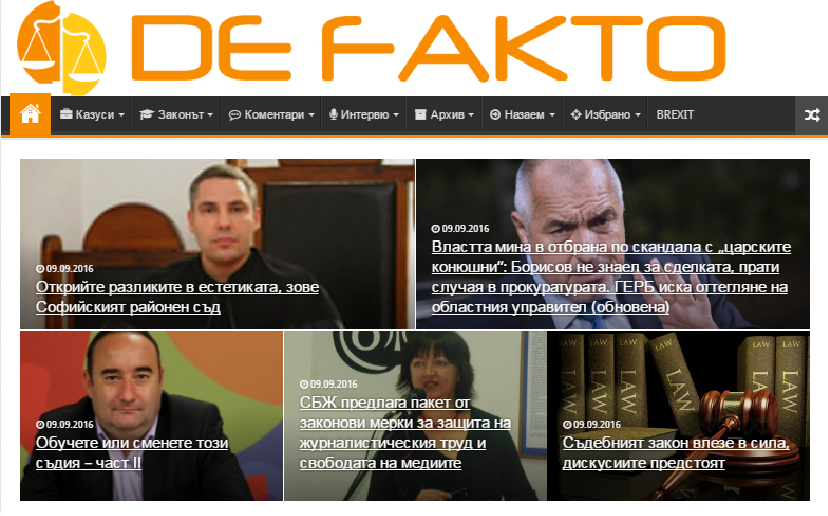
Train or replace this judge* – Part II
Tony Dimov, lawyer, Doctor of Law, Chairman of the Center for Regulatory Impact Assessment (www.ria.bg)
A few months ago, in mid-June 2016, you – the friends, colleagues and like-minded people of de facto legal (DE FAKTO) – were the first with whom we shared our pain and the sense of lawlessness created by a Bulgarian court in the registration procedure for an ordinary association with no legal or factual complexity whatsoever, a non-profit association designated to carry out activities in the public benefit, founded by several Bulgarian public figures, professors and lecturers in economics and law.
Now we want you again to be the first with whom we share our joy and the feeling that there is justice in our country after all. Yes, a feeling of joy that, after much time and effort, you have managed to help bring a procedure to a successful end. It may sound absurd or pitiful, but that is reality. It is time for the sequel to our saga “Train or replace this judge” with Train or replace this judge – Part II.
Besides you, during the long period of lawlessness into which the registration procedure of the association in question fell, we also reported the case to the “competent” institutions, such as the Ministry of Justice, the Central Register of Non-Profit Legal Entities for Public-Benefit Activity, the Inspectorate of the Supreme Judicial Council and others. “Competent” in inverted commas, because it was clear to everyone that as long as an appeal was possible the dispute was pending and no one would commit to a specific position. The Central Register of Non-Profit Legal Entities helped us with data and information. Only the Ministry of Justice, and informally at that, encouraged us to appeal and to fight to the end for the protection of human rights in our country.
And that is what we did. We appealed the refusal to register the association issued at the beginning of June 2016 by Judge Liliya Ilieva. Within just two working days the Sofia Court of Appeal revoked the refusal and ordered the immediate registration of the association, as originally applied for. The Court of Appeal, rather delicately and “collegially”, did not rule on the general questions we raised – why Judge Ilieva did not apply the correct procedural law, why she applied the substantive law inaccurately and why she did not respect the legal custom and the case law accumulated over the last 15 years. To Ilieva’s unceremonious “reasoning”, with which she had suspended the proceedings – “the association is no institute at all”, the Court of Appeal replied that “there is no legal act defining the name ‘institute’ as belonging exclusively to certain legal entities of a distinct quality, and therefore the name of the association is not misleading.”
How can we not rejoice that justice ultimately prevailed… That, however, is where the joy and the good part of the saga end.
Many questions remained open and unanswered for us, which we will ask here too:
1. Must the court know the procedural law? Because in this particular case Judge Liliya Ilieva, instead of applying the special rules of Chapter 55 “Registration of legal entities” of the Civil Procedure Code, wrongly applied Art. 540 in conjunction with Art. 129, para. 3 of the Civil Procedure Code, which lay down the rules for checking the regularity of a statement of claim? And what should be the fate of a judge who does not know and does not apply the correct procedural law?
2. Must the court know the substantive law? Because in this particular case, both times Judge Liliya Ilieva relied on the substantive law to issue her refusal – Art. 3, para. 3 and Art. 7, para. 2 of the Non-Profit Legal Entities Act – she applied the law wrongly? And what should be the fate of a judge who does not know and does not correctly apply the substantive law?
3. Must the court know the case law and observe legal custom? Because in this particular case, to our arguments that more than 15 years of practice in applying the Non-Profit Legal Entities Act have resulted in over 340 non-profit legal entities named “institute” being registered in the register of the Sofia City Court alone, and over 150 institutes in the Ministry of Justice register of public-benefit non-profit legal entities, the court replied as follows: “His arguments that there are many registered non-profit legal entities with ‘institute’ in their name should not be accepted either. If a mistake has been made, it should not be multiplied ad infinitum…”? And what should be the fate of a judge who does not know the case law, refuses to take it into account when it is pointed out, and does not observe legal custom?
4. Are expressions such as those used in Judge Liliya Ilieva’s “reasoning” in this case, in official acts of a Bulgarian court, socially acceptable and compatible with the generally accepted moral norms and ethical requirements for Bulgarian magistrates:
– “the association is no institute at all.”
– “Nothing can be understood from the applicant’s explanation, except that it insists on its unlawful name …”; – “This ‘mission’ is developed into six objectives, which look very good on paper …”;
– “The applicant’s behaviour shows that it is not so much concerned about the future of small and medium-sized enterprises in our country as about its ‘recognisability’ by the European Commission”, and others? And what should be the fate of a judge who uses such expressions in her official judicial acts?
5. Is it acceptable today, in the 21st century, in Bulgaria, for the registration of a non-profit association – with such a clear and comprehensive legal framework and without any practical or legal complexity – to take more than five months, and who should be held responsible for such poor and delayed justice?
Most of these questions are rhetorical. In this case, however, a judge, in a way unacceptable from a moral and professional point of view, has in practice crossed out and denied the existence of fundamental human rights, such as the right to freedom of association. From this point of view, the above questions can be reduced to one: is Bulgaria a state governed by the rule of law, or rather a semblance of one? If there are no basic guarantees for safeguarding and protecting human rights, if the court obstructs, delays and insults people who want it to help them associate in the manner prescribed by law, then justice and the rule of law in the state, the supremacy of law and civil society are just words written on paper – even if that paper is entitled Constitution – or theoretical concepts in the heads of lawyers, specialised journalists or scholars working in the field of law.
In our view, it is high time to create in Bulgaria an integrated specialised protection mechanism in the form of a National Human Rights Institution, guaranteeing compliance with the Constitution of the Republic of Bulgaria and the European Convention for the Protection of Human Rights, which would be triggered automatically and immediately and would work simultaneously as prevention, ongoing monitoring and subsequent control of compliance with fundamental human rights in all cases similar to ours.
Until then, we ask again: “Train or remove this judge”.
Train or replace this judge* – Part I
Tony Dimov, lawyer, Doctor of Law
* I admit that I borrow the exclamation in the title from my teacher Prof. Ognyan Gerdzhikov, who two weeks ago, on another occasion, erupted: “Stop this vocabulary!”
As someone who has worked on the legal framework of non-profit legal entities since 2000 – which, in a broad sense, include parties – I am 99% sure that the three orders by which the Sofia City Court refuses to admit for consideration the documents of a party are not due to any personal attitude or some secret judicial or state conspiracy against its founder, but to the personal decision of the particular judge.

I say this with such a high degree of conviction because the Center for Regulatory Impact Assessment, which I head, is currently fighting a very similar case of registering a non-profit association before the same judge, who in a similar way, on an identical procedural basis and with similar arguments, has issued 3 consecutive orders refusing to admit the documents submitted for consideration, while absurdly ruling on their merits at the same time.
At the beginning of April 2016 several Bulgarian public figures, professors and lecturers in economics and law, and well-known personalities decided to found a public-benefit non-profit association, naming it “Institute for ….” something, i.e. using the word “institute” in its name.
To everyone’s great surprise, the court issued an order saying that the name was misleading because, I quote “the association is no institute at all.” The full stop at the end of these words is inside the quotation marks for a reason, because that is where the court’s “reasoning” ends, i.e. there is no reasoning. Accordingly, the court instructs that a new letter on the uniqueness of the name be submitted and the statutes be revised in this respect. At the end of the order the court warns that if the instructions are not complied with within 7 days of their notification, pursuant to Art. 540 in conjunction with Art. 129, para. 3 of the Civil Procedure Code, the application will be returned and the registration proceedings terminated.
The problems
What do the problems consist of? The court wrongly applies the procedural law, shows complete ignorance of the practice of applying the substantive law over more than the last 15 years and behaves unacceptably by using inadmissible expressions that sound insulting to the founders and to experts in the field, which as a whole is a very bad signal about the level of development of our state, democracy, civil society and society as a whole.
On the wrong application of the procedural law
Art. 540 of the Civil Procedure Code provides that the rules of contentious proceedings apply accordingly to non-contentious proceedings. On this basis the court applies Art. 129, para. 3 of the Civil Procedure Code, which concerns the checking of a statement of claim and provides that when a claimant fails to remedy the irregularities in the statement of claim within the time limit, it is returned together with its annexes. An irregularity in a statement of claim means the absence of one of the elements specified by law as its mandatory content.
However, the Civil Procedure Code has a separate Chapter 55, entitled “Registration of legal entities”, whose scope covers the registration of the formation, transformation, liquidation and termination of all legal entities where the law provides for registration in a court register. Articles 600 and 601 of this chapter state that the proceedings begin with a written request, which must contain the name and address of the person making the request, the type, name and seat of the legal entity and the circumstance whose registration is requested. Within the regularity check, the court should check whether the content of the request meets these legal requirements and rule on it, which concludes this phase of the proceedings. It can end with admitting the request and examining it on the merits, or with returning it.
In our case, however, in these proceedings for checking the application, the court says it found “irregularities in the statutes” and discusses the name of the association and its object of activity, i.e. it examined the documents on the merits, while at the same time not admitting them for consideration. To date, in more than 15 years of the Non-Profit Legal Entities Act being in force, none of the more than 20 regional courts in Bulgaria has had such a practice. There is nothing wrong with a judge deciding to pioneer a new practice in applying the law, as long as it is not as absurd as this one.
The court tells the founders: you have no right to associate in such a way as to call yourselves an institute. I forbid it already at the level of checking the regularity of your application. Go and reserve a new name, i.e. pay another insane BGN 60 fee. Change your statutes, i.e. go through the whole founding procedure, gather the founders again to sign minutes and statutes, certify new specimen signatures of the representatives and incur new costs for notarisation. You must do all this within 7 days of the notification of my order, and then come back to me.
This is called blocking from the outset the citizens’ right of association guaranteed by the Constitution of the Republic of Bulgaria and the European Convention for the Protection of Human Rights and Fundamental Freedoms.
On the ignorance of the practice of applying the substantive law
In our fight against this new absurd practice of the court, besides referring the matter to all the institutions concerned, most of which replied that they could not rule while the dispute was pending, we also did a quick search online.
It turned out that the Central Register of Non-Profit Legal Entities at the Ministry of Justice – where only public-benefit organisations are registered, which are about 1/3 of all NGOs in Bulgaria, and only those wishing to have full status – contains 155 foundations and associations with the word “institute” in their name.
A search of the Bulstat register showed that over the last 15 years the Sofia City Court itself has registered 345 foundations and associations that call themselves institutes. Incidentally, some of the best-known non-governmental organisations in Bulgaria have this word in their name: the Institute for Market Economics, the Open Society Institute, etc.
The denouement
After more than 2 months lost in the proceedings on the regularity of the request, and although each of the court’s three orders ends with the words that if the instructions are not complied with the request will be returned, the court suddenly issued a decision by which itrefuses initial registration. Without having ruled on the regularity of the request, the court suddenly decided that it was regular and that it would not return it to its sender, and examined the documents on the merits.
Commenting on the statutes of the future association, the court makes the following gems:
“This ‘mission’ is developed into six objectives, which look very good on paper …”;
“The applicant’s behaviour shows that it is not so much concerned about the future of small and medium-sized enterprises in our country as about its ‘recognisability’ by the European Commission”;
“His arguments that there are many registered non-profit legal entities with ‘institute’ in their name should not be accepted either. If a mistake has been made, it should not be multiplied ad infinitum…”. A unique state…
On the unacceptable conduct of the court
Whatever kind of people the applicants and founders are, they are owed respect. The court’s only reason for refusing to help Bulgarian citizens exercise their constitutionally guaranteed right of association – already at the level of the regularity of the request – cannot be the insulting declaration: your association is no institute at all. After these people, through their consultants, made enormous efforts to explain to the court not only that they insist on exercising their fundamental human right as they have decided but also that it is key for them to keep the word “institute” in the name of their association, in the third order of the same kind the court tells them the following:
„Nothing can be understood from the applicant’s explanation, except that it insists on its unlawful name …”. Even more insulting than the previous one…
Lately there has been much talk about the mentality of the Bulgarian judge, and about how arrogance and the sense of unlimited power stemming from the inviolable inner conviction of the judge are outdated and retrograde, and that it is time for them to give way to openness to society, a positive attitude towards citizens and thinking outside the box. If you go today and ask the judge in question: excuse me, why are you doing all this? For two months these people have been unable to do something elementary – register an association in Bulgaria so they can start working for the benefit of society, which in civilised countries happens electronically, impartially and without arrogance in 3 to 5 days – she will surely answer: because I decided so, it is my inner conviction, I will rule as I please and no one can tell me anything …
We could have advised the founders, as early as the court’s first order, to wait for the deadline to expire, take their documents back and file them again so that they would land with another judge of the Sofia City Court, or file them with the Sofia Regional Court or another court, but that would have meant giving up the fight for the protection of fundamental human rights.
That is why we ask: “Train or remove this judge”